Charging From 10% to 80% in 12 Minutes: What It Means Daily
A 12-minute rapid charge sounds like a marketing line until you translate it into percentages: 70 percentage points of state of charge in 12 minutes works out at roughly one point every 10 seconds. The New G6 publishes exactly that window on its 5C battery, and the same figure appears across the 800V platform. This piece explains what the number assumes, where the plug goes and what a stop really costs you in time.

Key takeaways
- 12 minutes covers 10% to 80% state of charge on the 5C battery, and 15 minutes is quoted for up to 427 km of charge in internal RWD Long Range tests.
- Public charging works on most Type 2 (AC) and CCS2 (DC fast) units; the flap lives on the right rear quarter panel.
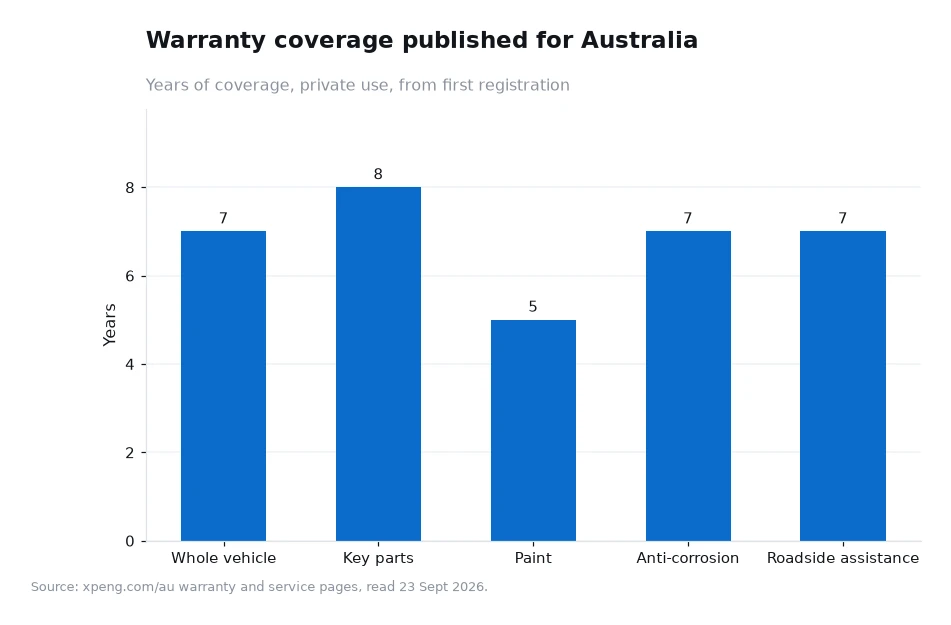
- Whole vehicle cover lasts 7 years / unlimited km, key parts 8 years / 160,000 km, paint 5 years and anti-corrosion 7 years.
- Home charging changes the daily maths: most weeks never need a public stop at all.
Reading the 12-minute claim properly
Every rapid-charging figure in the industry describes a window, not a full battery. Here the window is 10% to 80% state of charge, the band where a lithium battery accepts power fastest. Below 10% the car is protecting itself; above 80% the charging rate tapers so the cells are not stressed. Quoting the middle band is therefore the honest comparison point, because it is the part of the curve a driver actually uses on a long trip.
The hardware behind the number is a full-domain 800V high-voltage silicon-carbide platform with 5C supercharging, which the manufacturer headlines as Australia's first 5C AI battery in the New G6. The car is built to arrive at a charger warm, accept a large amount of power for a short time and leave. In practice a stop of 12 minutes depends on the charger you find, the ambient temperature and how low you let the battery fall before plugging in, so treat the published figure as the best case the hardware is designed around.
Plugs, cables and where you can charge
The charge flap is on the right rear quarter panel: press the top-left corner and it releases, then connect the cable. The car is compatible with most public Type 2 (AC) chargers and CCS2 (DC fast) chargers, which between them account for the great majority of public points in Australia, from shopping-centre bays to highway rapid sites. Nothing here requires a proprietary plug, which matters when you are planning a route through towns you have never visited.
The one caveat worth knowing concerns the Tesla network. Some Tesla Supercharger sites in Australia are open to non-Tesla CCS2 vehicles, and not all of them are, so the manufacturer's advice is to check the Tesla app for site compatibility before building a plan around one. For home and business use, XPENG also offers its own high-power DC unit, described as a 480 kW charger with a 670A+ flow rate, liquid cooling, IP67 protection and a built-in safety monitoring chip.
Think of the two connector families as different tools. An AC point is where the car spends a working day or a night: a 10-amp or 32-amp supply, a cable, and no need to think further, because the charging schedule can be set to run during off-peak hours. A DC rapid site is the opposite: you arrive with a low battery, the car accepts power as fast as the battery and the charger allow, and you leave inside a quarter of an hour. Temperature plays a part in both cases, and the manufacturer's footnote is clear that the figures depend on conditions, which is why a stop on a 40-degree afternoon may take longer than one on a mild morning.
| Connector | Typical use | What to confirm |
|---|---|---|
| Type 2 (AC) | Home wallbox and destination parking | Overnight top-up and charging schedule |
| CCS2 (DC fast) | Highway and town rapid sites | Compatibility is described as most, not all |
| Tesla Supercharger (CCS2) | Some Australian sites open to other brands | Site compatibility in the Tesla app |
| XPENG high-power DC | 480 kW unit, 670A+ flow rate | Suitability for your site and power supply |
Worked example: what a 12-minute stop buys you
This is an example using the published window, not a test result. Assume each stop runs from 10% to 80% state of charge, a span of 70 percentage points, and takes 12 minutes. Divide the time by the span: 12 minutes divided by 70 points is 0.171 minutes per point, or about 10.3 seconds for every 1% of charge. That is the rate the car is built to hold inside the window.
Now reverse it. If a stop is stretched from 12 to 15 minutes, the same rate covers 70 multiplied by 15 divided by 12, which is 87.5 percentage points - more than the window allows, so a 15-minute stop is enough for a full rapid session with a few minutes spare for the cable and the app. Stretch the arithmetic over a long drive instead: three stops of 12 minutes add up to 12 + 12 + 12 = 36 minutes of charging, which is the cost of crossing about 1,000 km in the illustrative plan used further down this page.
What sits behind the charging: cover and servicing
A car that charges quickly still has to be owned, and the published terms are worth reading alongside the charging numbers. Whole vehicle cover runs seven years or unlimited kilometres for private use, or seven years and 160,000 km for commercial use, whichever comes first. Key parts - traction battery, battery management system, drive motor and intelligent power unit - are covered for eight years or 160,000 km, paint for five years with no distance limit, anti-corrosion for seven years and roadside assistance for seven years from first registration.
Scheduled maintenance is listed at every 12 months or 20,000 km, whichever comes first, through an XPENG Authorised Dealer, and the traction battery warranty provides a minimum of 70% of original capacity during the key-parts period. Gradual capacity loss is described as normal for traction batteries, which is a useful sentence to remember when a three-year-old car shows a slightly lower range estimate than the day it was delivered.
Frequently asked questions
How long does a rapid charge actually take?
The published figure is 10% to 80% state of charge in 12 minutes on the 5C battery. Real stops depend on the charger's output, the battery temperature and the state of charge when you plug in, so treat 12 minutes as the rapid window the car is built around.
Can the car use any public charger in Australia?
XPENG vehicles are compatible with most public Type 2 (AC) and CCS2 (DC fast) chargers. Some Tesla Supercharger sites in Australia are open to non-Tesla CCS2 vehicles, and the advice is to check the Tesla app for site compatibility first.
The next practical step
Work out your own week before you decide anything. Measure the return trip to work, count the nights the car sits in a driveway, and mark the long drives you make twice a year. If those long drives are few, a home Type 2 supply plus the charging schedule in the car app will cover almost everything, and the XPENG electric suv guidance on the brand's own pages will fill in the rest.
When you do compare models, compare them on the window that matters: how fast each one refills between 10% and 80%, what the cover says about the battery, and how far you would have to travel for servicing. The XPENG X9 seven-seater uses the same 800V approach and publishes the same 12-minute window, so the comparison is easy to hold in your head. Booking through a dealer is the last step, and the charging pages give you the wording to check against the sales conversation.
Charging figures, warranty terms and service intervals come from the manufacturer's Australian pages, read 23 Sept 2026; the 12-minute window applies to 10-80% state of charge and the 427 km figure comes from internal tests of the G6 RWD Long Range. WLTP range depends on conditions, and XPILOT ASSIST is an assistance function where the driver remains responsible for monitoring traffic.[1]