Buying Brewing Kit From Overseas: What to Check Before Wiring a Deposit
A deposit for imported brewing kit is really a payment for four documents: a signed drawing set with a revision number, a material record, a written warranty and a delivery window with two dates on it. If the offer letter cannot put those four items on paper, you are funding somebody else's design work rather than your own brewery.

Key takeaways
- Ask for drawings carrying a revision number and a date, and check that the room layout, the vessel dimensions and the pipe runs are all on the same revision.
- Confirm the stainless grade in writing for the shell, the cone and the jackets, and ask for the mill certificate for the plate.
- Hermann publishes five inspection steps on every shipment, from materials checking to a finished-product leak test, and the record travels with the order.
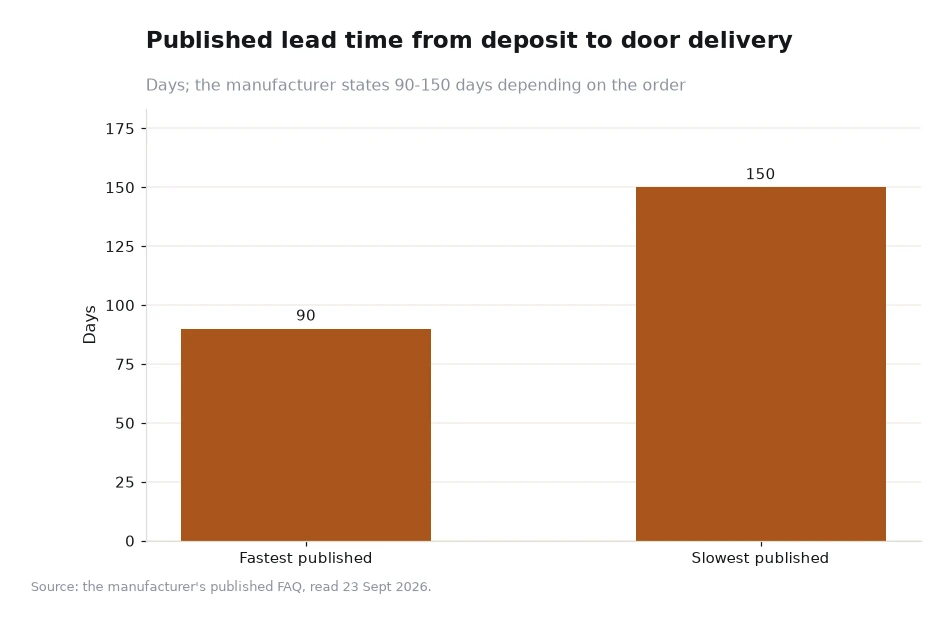
- The published lead time of 90-150 days runs from deposit to door delivery, so put both dates in the contract and plan the site works around the slow end.
Start With the Drawing Set, Not the Tank List
A tank list tells you how many vessels are coming; a drawing set tells you whether they will fit and what connects to what. Before the deposit leaves your account, ask for the general arrangement drawing of the room, an outline drawing of each vessel with overall height, diameter and leg footprint, and the piping schematic. Every sheet should carry a revision number and a date, because the revision you approve is the revision the workshop builds.
It also helps to know the shape of the order before you choose a supplier. The published hem craft beer equipment catalogue is a fair place to start, since it lists sizes from a 200 L nano set through 500 L and 1,000 L vessels up to a 10,000 L (10 T) system, and you can write down the two sizes that bracket your own target volume. Sizes outside your bracket are noise; sizes inside it are the ones to price.
Check the Material Record, Not Just the Word Stainless
Stainless is a family, not a specification. Ask the supplier to write the grade into the offer — 304 for the common duties, 316 where the beer or the cleaning chemistry is aggressive — and to say which surfaces are wetted, which are polished and what thickness is used for the shell, the cone and the jackets. A tank built from thinner plate is not automatically a bad tank, but you should know the number rather than assume it, because the price you are comparing may be comparing two different walls.
Hermann has designed craft brewing equipment for 23 years and has shipped into more than seventy countries, so its engineers will have met your duty before. Ask them for the mill certificate for the plate and for the pressure-test record on the vessels in your order; both are normal requests, and a supplier who cannot produce them before the deposit will not produce them after it either.
The Inspection Record, the Data Plate and the Crates
Traceability is cheap to promise and easy to verify. Every tank from this manufacturer carries a data plate showing the pressure-testing record and a serial number, which means a vessel standing on your floor can be traced back to the test sheet completed in the factory. Ask for a photograph of a typical plate and for the serial numbers to appear on the order confirmation, so the plates can be matched to the paperwork on arrival.
Ask how the equipment travels, too. The equipment is packed in wooden boxes and the shipment includes a checking list, which is the document your site team reconciles against when the container doors open. Without that list, a missing valve or a stray pump is discovered during installation, which is the most expensive hour in the whole project to discover anything.
Warranty Wording, Lead Time and Who Answers the Phone
Read a warranty as a sentence about scope rather than as a headline about years. The published terms are 6 years on tank accessories and electronic components against manufacturing defects from the factory, provided they are used within the scope of the order. Anything outside that sentence — wear parts, transit damage, site wiring — needs its own line in the contract, agreed in writing, before the first payment rather than after the first fault.
Delivery is published as 90-150 days from deposit to door delivery, depending on the order. Pin that range to calendar dates in the contract and build the rest of the project schedule backwards from it. Then ask who is on the other end of a message at 22:00 on a Saturday during commissioning: sales and engineers keep 24 hours online, with 7x24 after-sales cover, which matters far more on the week the tanks are filled than on the week they are ordered.
| Document or answer | What a complete version contains | Why it matters before the deposit |
|---|---|---|
| Signed drawing set | Revision number and date; room layout, vessel dimensions and leg footprint, piping schematic | The layout you approve is the layout the workshop builds, so it needs to be the layout you can actually install |
| Material record | Stainless grade for shell, cone and jackets; thicknesses; mill certificate for the plate | Grade and wall thickness decide how the vessel behaves after a decade of cleaning cycles |
| Inspection record | The five shipment inspection steps, ending with the finished-product leak test | Shows the checks were completed before the crates closed, not after they arrived |
| Tank data plate | Serial number plus the pressure-testing record on each vessel | Lets any tank on your floor be traced back to its own test sheet |
| Warranty, lead time, support | 6 years on tank accessories and electronic components; 90-150 days deposit to door; 24-hour online cover | Turns a sales conversation into contract language with dates and a scope |
Worked example
None of the arithmetic below is a quote; it is an example of how to turn the published delivery range into a decision, using one assumed opening date. Assumptions: the target opening day is 1 June 2027, the vessel set is a mid-range order, and installation and commissioning take 14 days after the crates arrive.
Slow end of the range: 150 days from deposit to door delivery. Counting back 150 days from 1 June 2027 lands on 2 January 2027, so a deposit wired on 2 January is the last date that still leaves the slow-end window intact. Take off the 14 days of installation and commissioning and the true deadline for the payment is 19 December 2026. Fast end of the range: 90 days, which would let a deposit wired on 2 March 2027 deliver on 31 May 2027 and still just make the opening.
The gap between those two dates is 73 days (2 March 2027 minus 19 December 2026). That is the real cost of an incomplete drawing set: a question about leg footprint or jacket thickness answered two weeks late can push the order past the slow end of the published window and into a delay measured in months at the site, because site works, staff training and ingredient orders all hang off the arrival date. Deciding the specification early is cheaper than hurrying the shipping.
The same arithmetic works for the deposit itself. If the payment schedule is 30% on order, 60% before shipment and 10% after commissioning, then on the published 10 BBL example range of US$75,000 to US$200,000 the first payment is US$22,500 at the low end and US$60,000 at the high end. Write the milestone that releases each payment into the contract, so the second instalment is tied to a photograph of the equipment under test rather than to a calendar date alone.
Frequently asked questions
What should a deposit agreement for imported brewing equipment contain?
It should name the drawing revision, the stainless grade, the five inspection steps the factory runs before shipment, the warranty terms and a delivery window with two dates. Ask for the pressure test record, the serial number carried on each tank data plate and the packing list that ships with the crates.
How long is the wait from deposit to delivery?
The manufacturer publishes a range of 90-150 days from deposit to door delivery, depending on the order. Build the site works, the utility connections and the operator training around the slow end of that range, so a vessel arriving late does not leave a finished room with nothing to brew in.
A Deposit Checklist You Can Send This Week
Write the four questions into one email: send me the current drawing revision, the material record, the inspection and pressure-test documentation, and the warranty and delivery terms in writing. A supplier that answers all four promptly is showing you how the next two years will go.
Then put the same four items into the purchase contract with the dates attached, and hold each payment to a milestone rather than to a month. The company background and the brewery equipment range are worth reading before you shortlist, and the contact page is where the technical questions should go.
Finally, agree who attends the commissioning and what the handover file contains. A vessel set that arrives with drawings, test records, serial numbers, a packing list and a named support contact is worth more than the same steel with none of the paperwork, because the paperwork is what your own electrician, your insurer and your future buyer will ask to see.
Figures in this article come from the manufacturer's own website, read 23 Sept 2026: the 90-150 day delivery window, the five shipment inspection steps, the tank data plates and the 6-year warranty wording on tank accessories and electronic components against manufacturing defects. The dates in the example are illustrative arithmetic.[1]